The night before our national exams in Kenya, my classmates and I would stay up late reciting paragraphs we had memorized word-for-word from textbooks. Not because we understood them. Because we knew the marking scheme rewarded recognition, not reasoning.
I was good at that game. I passed.
Years later, sitting in a 500-seat lecture hall called “Bs” at Egerton University, squinting to make out a lecturer whose voice barely reached the back row, scrambling to copy notes I’d later regurgitate in a closed-book exam. I started asking myself a question I haven’t been able to shake since:
Did I ever actually learn anything? Or did I just learn how to perform learning?
Two thinkers helped me make sense of that question. One is a cognitive scientist. The other is a biologist. They come from completely different worlds, and they say the same uncomfortable thing.
Roger Schank: Teaching is not telling
Roger Schank spent his career at Yale, Northwestern, and Carnegie Mellon before concluding that most of what we call “school” is fundamentally misconceived.
His argument in Teaching Minds (2011) is blunt: schools have confused the transmission of knowledge with the development of intelligence. We organize education around subjects like math, history, biology, and literature because that’s how universities are organized. But the human mind doesn’t actually learn that way.
What we need to develop, Schank argues, are cognitive processes: prediction, diagnosis, planning, causal reasoning, argumentation, and self-knowledge. These aren’t taught by being told. They’re built by doing.
His sharpest line stays with me:
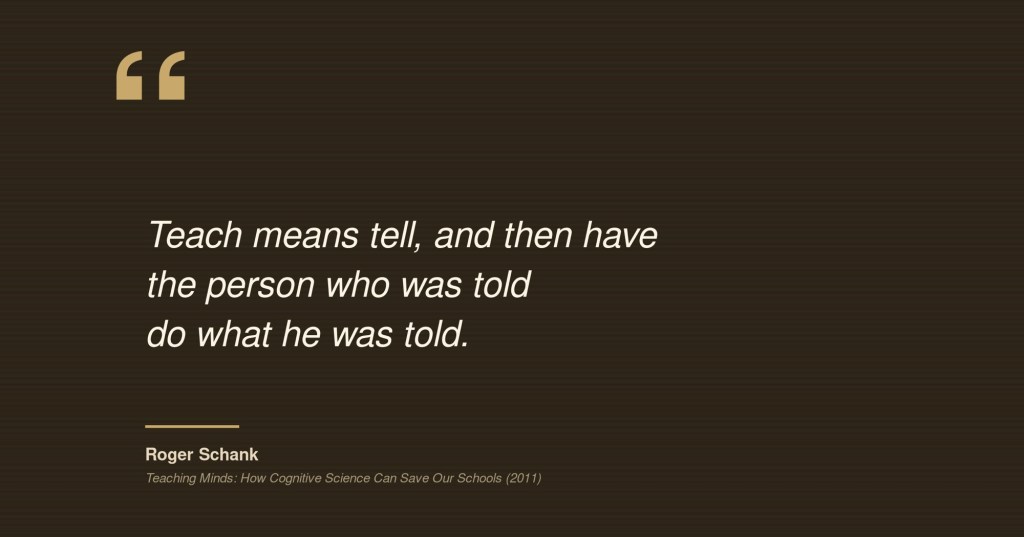
“Teach” means to tell, and then have the person who was told do what he was told”.
Reading that, I thought of every lecture hall I had ever sat in. The teacher talked. We listened, or pretended to. Then there were grades. The whole arrangement assumed that listening was learning. It is not.
James Zull: Learning is biology
James Zull, a biologist who ran a university teaching center, comes at the same problem from a completely different angle. His starting line in The Art of Changing the Brain (2002) is disarmingly simple:
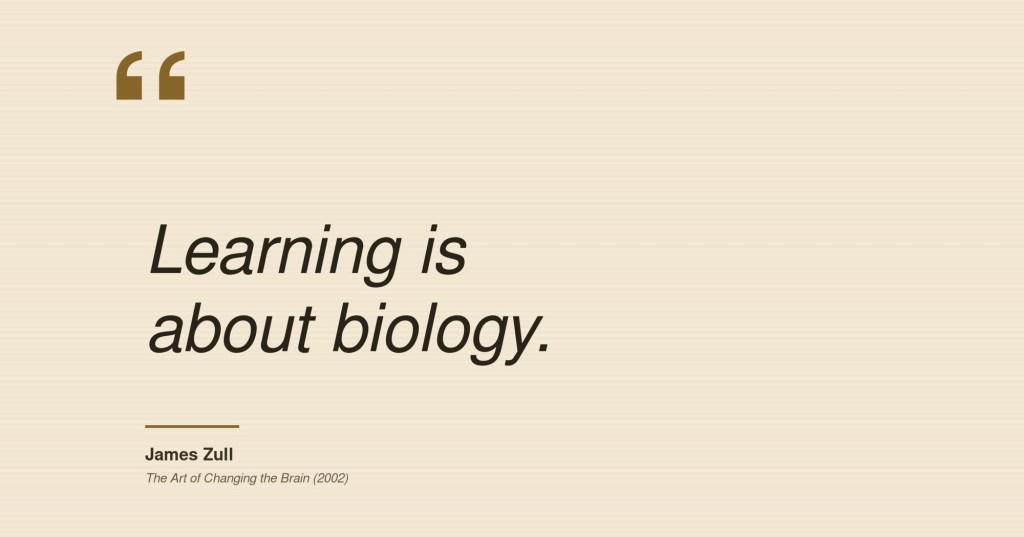
For Zull, teaching is the art of changing the physical structure of the brain. And that change only happens when the learner moves through all four stages of what he calls the learning cycle:
1. Concrete experience—taking in something through the senses (sensory cortex).
2. Reflective observation—making meaning of it (back integrative cortex).
3. Abstract hypothesis—generating your own ideas about it (frontal integrative cortex).
4. Active testing — doing something with those ideas (motor cortex).
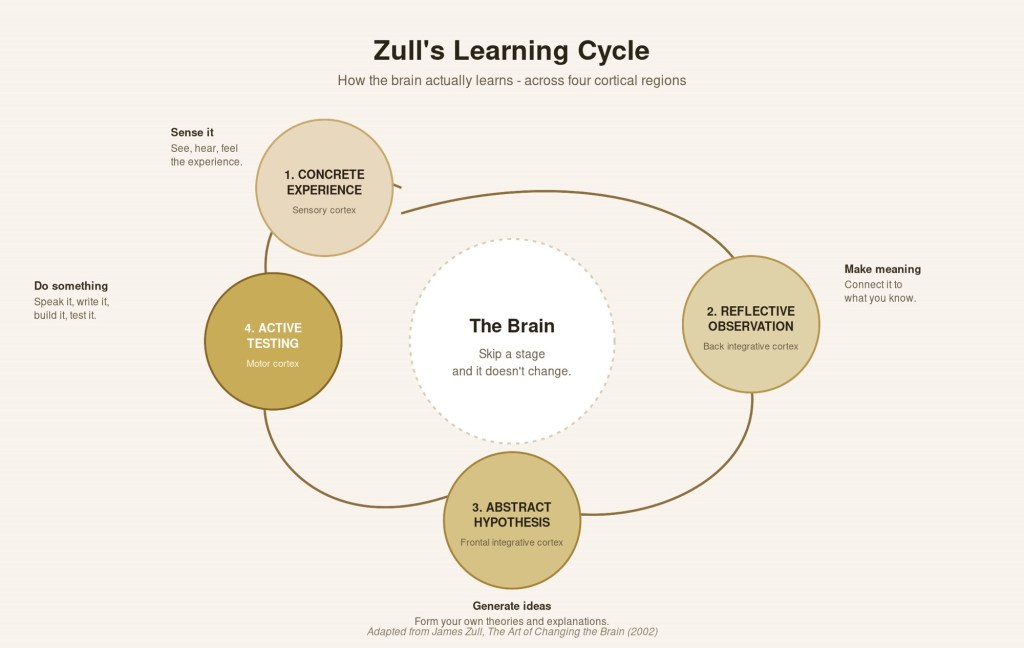
Skip any stage and the brain doesn’t fully change. You’ve stored some information. You haven’t learned.
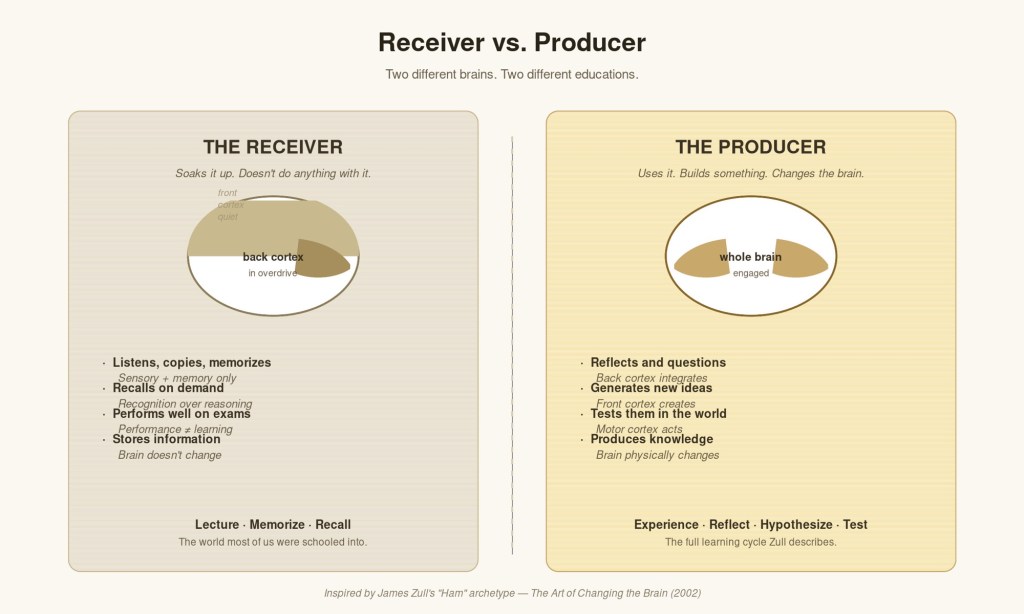
Zull describes a student archetype he calls “Ham,” someone who soaks up information, remembers a great deal, and never does anything with it. Ham, biologically speaking, is living on one side of his brain. He is a receiver, never a producer, of knowledge.
I read that passage and recognized myself. I had been Ham. We had been trained to be Ham.
What both of them are really saying
Schank and Zull start in completely different places, artificial intelligence and cellular biology, and arrive at the same diagnosis.
Passive reception is not learning.
You can sit, listen, copy, and memorize for sixteen years and still graduate without the cognitive equipment that adult life and meaningful work actually require. Not because you’re lazy or unintelligent, but because the system you went through was never designed to develop those capacities in the first place.
Both also insist that emotion and motivation matter. Schank calls it goal alignment: humans learn what they actually want to learn. Zull points to the emotional centers of the brain that modulate memory and attention. An education that ignores what students care about is working against its own biology.
What the Kenyan classroom taught me about the science
Looking back at my schooling through their lens is sobering.
The 8-4-4 system I went through was, structurally, the kind of education both theorists describe as broken. Curriculum organized around subjects and exam content rather than cognitive growth. Classes are taught by chalk-and-talk to forty or fifty kids at a time. Universities where you literally couldn’t hear the lecturer from the back rows because of lack of PA capabilities. Assessment that rewarded the reproduction of model answers and quietly punished the student who came up with her own.
We mastered the first half of Zull’s cycle, sensory input and memory, and almost never got to the second half, where actual thinking happens. We checked almost none of Schank’s cognitive process boxes. We learned to perform learning.
And here’s the part that matters for everyone, not just Kenyans: this isn’t only a Kenyan story. The lecture hall, the closed-book exam, and the curriculum-as-coverage model—these patterns show up in classrooms all over the world. Anywhere education is structured around transmitting content rather than developing minds, the same gap opens up between schooling and learning.
What I’m taking from this
I’m not writing this to dismiss my education. It got me into rooms I would not otherwise be in. The teachers I had were doing their best inside a system they did not design.
But I am writing it because I think most of us, students, professionals, parents, and leaders, carry around a quiet version of the same question I had in that lecture hall. Did I really learn that? Or did I just memorize it well enough to pass?
A few things I’m trying to do differently now:
· Treat learning as something I do, not something done to me. If I can’t apply, explain, or argue with an idea, I haven’t learned it.
· Move through the whole cycle. Read, yes, but also reflect, hypothesize, and test. Write the post. Build the prototype. Have the conversation.
· Pick goals first, content second. What do I actually want to be able to do? Then I’ll find the books, courses, and people that serve that.
· Be patient with my own brain. Real learning is a physical change. It is supposed to feel slow.
The promise of education has always been that it changes you. Schank and Zull, in different vocabularies, are saying the same thing: that promise is real, but it’s only kept when learning becomes active, goal-directed, and complete.
I wish someone had told me that on the night before the exam.
Have you ever felt the gap between schooling and learning in your own life? I’d love to hear how you’re closing it.
Sources: Roger Schank, Teaching Minds: How Cognitive Science Can Save Our Schools (2011); James Zull, The Art of Changing the Brain (2002).


Leave a comment