Category: Uncategorized

  • The Alien in the Room: What AI Means for Education and Healthcare in Kenya

    Nairobi Skyline at Dusk by Ken Mwaura

    Reflections from a Kenyan international student, drawing on Ethan Mollick’s Co-Intelligence: Living and Working with AI and Our Next Reality, explored in Professor Greg Kessler’s Emerging Technology course at Ohio University

    Last semester, I sat in Professor Greg Kessler’s Emerging Technology course at Ohio University and read two books back-to-back that genuinely unsettled me, in the best possible way. The first was Ethan Mollick’s Co-Intelligence: Living and Working With AI. The second was Our Next Reality, which painted an even broader canvas of where immersive and intelligent technologies are taking us. Together, they did something I did not expect they made me think constantly about home.

    I came to Ohio University from Kenya, first completing my MA in International Studies and now pursuing a PhD in Instructional Technology. Those two degrees sit at an interesting crossroads, one trained me to think about global inequalities of power, resources, and opportunity; the other is training me to think about how technology can reshape learning. Reading Mollick in that context was not an academic exercise. It was personal.

    There is a moment, Mollick writes, that comes after a few hours of really using an AI system, a moment where you stop thinking of it as a clever search engine and realize you are dealing with something genuinely new. Something that thinks, responds, and adapts in ways that no piece of software has ever done before. He calls it the cost of “really getting to know AI”, at least three sleepless nights. Kenya, as a country, is standing at the edge of those sleepless nights right now.

    We talk a lot about AI as something happening elsewhere, in Silicon Valley, in Beijing, in the research labs of universities most Kenyans will never attend. But Mollick’s central argument is worth taking seriously from a Nairobi matatu, a rural dispensary in Turkana, or a public school in Kisumu: AI is not a niche technology. It is what scholars call a General-Purpose Technology, a once-in-a-generation shift, like the steam engine, like the internet, that touches every industry and every aspect of daily life. And crucially, unlike those earlier revolutions which largely replaced physical or repetitive work, this one target thinking. It augments, and in some cases replaces, human cognitive effort. That changes everything for a country where the most urgent development problems are about access to expertise.

    The 2 Sigma Problem — and Kenya’s Version of It

    In 1984, educational psychologist Benjamin Bloom published what became known as the “2 Sigma Problem.” He found that students who received one-on-one tutoring consistently performed two standard deviations better than students in a conventional classroom. In plain terms: the average tutored student scored higher than 98 percent of students in a regular class. The problem? Private tutoring is expensive, scarce, and simply out of reach for most families.

    If you grew up in Kenya, you understand this problem intimately, not as research finding but as a lived reality. I grew up watching this gap up close. A student at a well-resourced private school in Karen or Lavington might have access to individual attention, specialist subject teachers, and exam prep coaching. A student at a public school in Mathare or Kitui is often sharing one underpaid teacher with sixty other children, in a classroom with no electricity, learning from a textbook that is five years out of date. It was that inequality, and a deep desire to understand how technology could bridge it, that eventually led me to Ohio University to study Instructional Technology.

    Happy Children in an African Classroom by Seyhmus

    AI does not fully solve this. Mollick is honest about that. But it creates something that has never existed before: a patient, tireless, personalized tutor that is available at any hour, in any subject, that will explain a concept fifty different ways until it clicks, and that is increasingly accessible on nothing more than a basic smartphone. Kenya already has some of the highest mobile phone penetration rates in Africa. The infrastructure for a tutoring revolution is already in Kenyan hands.

    This matters enormously at a practical level. Imagine a Form Three student in Eldoret struggling with quadratic equations at 9pm, when their teacher has gone home and there is no one to ask. Today, they give up. Tomorrow, with AI as a co-intelligence, they type their question into a chat window and get a step-by-step explanation tailored to exactly where they got confused. Not a YouTube video they have to scrub through. Not a Google result they must decipher. A conversation. Mollick calls this the promise of finally solving the 2 Sigma Problem at scale, and for a country like Kenya, it is among the most significant promises AI makes.

    A group of learners using smartphones during a lesson by RDNE Project

    The Homework Question (and Why It Is Not the Biggest Issue)

    Mollick notes, with a touch of dark humour, that even before generative AI arrived, Kenya had a thriving industry of approximately 20,000 people writing academic essays full time for students overseas. AI did not introduce the cheating problem to Kenyan education; it accelerated a tension that was already there.

    Reading that detail in Professor Kessler’s class, I almost laughed. Anyone who went through the Kenyan education system knows essay mills were not a secret. But Mollick’s point, and the conversation that Our Next Reality extends in its own way, is that the more important disruption is not about cheating. It is about what we teach and why. If AI can write a competent essay, summarize a textbook chapter, and solve most exam-style questions, then the purpose of education can no longer simply be content delivery. The real value of schooling shifts toward things AI cannot do: critical thinking, judgment, empathy, leadership, creativity rooted in lived experience. Kenyan educators and policymakers have an opportunity, right now to rethink curricula around these deeper skills, rather than defending assignments designed for a world that no longer exists.

    My PhD training in Instructional Technology keeps bringing me back to this question: what does it mean to design learning for a world where AI is always in the room? The answer is not to ban it or to surrender to it. It is to be deliberate. The calculator was once feared in classrooms. By the 1990s it was standard. The same adjustment will happen with AI. The question is whether Kenya’s education system shapes that transition deliberately or is shaped by it.

    The Doctor who is Never off Duty


    Healthcare worker in protective gear by Laura James

    Kenya has roughly one doctor for every ten thousand people. The World Health Organization recommends one per thousand. That gap, nine thousand people per available doctor, is not a statistic. It is a child in Garissa who waits weeks for a diagnosis. It is a mother in Migori who gives birth without skilled attendance. It is a community health volunteer in Baringo who knows something is wrong with a patient but does not have the training to name it.

    This is where Mollick’s framing of AI as co-intelligence becomes most powerful in the healthcare context. He describes AI not as a replacement for experts, but as something that brings expert-level capability to people who would otherwise never have access to it. Studies he cites show AI improving productivity in professional tasks by 20 to 80 percent, and critically, the gains are largest for people who are least experienced, because AI levels the playing field upward. A junior community health worker supported by an AI diagnostic tool is not a replacement for a doctor. But they are dramatically more capable than a community health worker working alone.

    This is not hypothetical. AI tools can already screen chest X-rays for tuberculosis with accuracy comparable to radiologists. They can analyze skin conditions from a photograph. They can triage symptoms, flag drug interactions, and surface relevant clinical guidelines in Swahili. These are not luxuries for a well-resourced hospital in Wetlands. They are survival tools for a dispensary in Wajir where the nearest specialist is four hours away.

    Kenya’s network of community health promoters, one of the largest and most organized in Africa, represents an incredible distribution channel for AI-augmented healthcare. Training those workers to use AI as a diagnostic co-intelligence could extend the effective reach of Kenya’s medical system without waiting for the country to train thousands more doctors it currently cannot afford.

    Rural Village in Lesotho by Fikelephi Ndisile

    Mollick does not write a utopian book, and this blog should not be a utopian piece. Neither does Our Next Reality, which pushed our class discussions in Professor Kessler’s course toward harder questions about who controls these technologies, who benefits, and who gets left behind when the next wave of immersive and intelligent tools arrives.

    The same AI that could personalize education for a child in Kibera could also flood social media with health misinformation in Kiswahili. The same tool that could help a community health worker in Turkana could widen the gap between those with reliable internet access and those without. AI will not automatically serve those who need it most, it will serve those who have the infrastructure, the literacy, and the policy environment to use it well.

    My background in International Studies trained me to be suspicious of technologies that promise to “leapfrog” development without asking whose interests they serve. The mobile money revolution with M-Pesa was extraordinary, but it happened because Kenya built the right conditions for it. The same intentionality is required now. This is the challenge for Kenya’s government, its tech community, and its civil society: to approach AI not as passive recipients of technology built for other markets, but as active co-designers of how it gets deployed here. That means investing in digital infrastructure in underserved counties, developing AI tools grounded in local languages and contexts, and building the regulatory capacity to manage risks before they become crises.

    Three Sleepless Nights

    Mollick ends his introduction with a simple observation: we are all going to have our three sleepless nights with AI. The question is not whether the technology will arrive in Kenya, it already has. The question is what we do with the excitement and the unease of those nights.

    I had my sleepless nights in Professor Kessler’s class in Athens, Ohio, thousands of miles from Nairobi. I read these books as a Kenyan living the strange double life of an international student, absorbing ideas from a well-resourced American university while thinking about classrooms back home that lack textbooks, and dispensaries that lack doctors. That distance is uncomfortable. But it is also clarifying. It made me see, with unusual sharpness, what these technologies could mean for a place that has more to gain from them than almost anywhere else on earth.

    For a country where the greatest inequalities are inequalities of access, access to quality teachers, to qualified doctors, to expert guidance of any kind, AI offers something genuinely extraordinary: the possibility of bringing world-class co-intelligence within reach of every Kenyan student, every rural health worker, every first-generation university student trying to figure out the world without a roadmap.

    That possibility is worth losing a little sleep over.

    Collins Ketere is a Kenyan international student at Ohio University, where he completed an MA in International Studies and is currently pursuing a PhD in Instructional Technology. This piece was written in the spirit of ideas explored in Professor Greg Kessler’s Emerging Technology course, where Ethan Mollick’s Co-Intelligence: Living and Working with AI (Portfolio/Penguin, 2024) was paired with Our Next Reality as companion readings.


     

  • When Control Kills Learning: Why Our Digital Classrooms May Be Working Against Us

    Photographed by Zoshua Colah

    I spent this semester writing a paper for my graduate program on something that’s been quietly nagging at me: the gap between what we know about how learning works and how we design the digital environments meant to support it.

    The more I read, the harder it became to ignore an uncomfortable conclusion. Many of the features we celebrate in learning management systems, like their efficiency, their analytics, and their tidy automation, aren’t pedagogically neutral. They quietly shape what learning becomes. And often, not for the better.

    Here’s the core idea, as briefly as I can put it.

    Learning requires risk. Our systems are built to remove it.

    James Zull, a neuroscientist who’s written extensively about how brains change through learning, makes a deceptively simple point: real learning is the literal physical reorganization of neural pathways. That kind of change doesn’t happen in comfort. It happens when learners encounter ideas that don’t fit their current understanding, when they sit with confusion, and, crucially, when they test their ideas in conditions where they might be wrong.

    Roger Schank, a cognitive scientist, makes the case even sharper: people learn by doing, failing, and figuring out why. Failure isn’t a bug in the learning process. It’s the engine.

    Now look at what most LMS-based environments are designed to do.

    1. Automated grading rewards correctness, not thinking.

    By Nguyen-dang

    Auto-graded assessments are particularly effective for vocabulary or procedural fluency. But they’ve quietly become the default for almost everything. The problem? To automate grading, you need predetermined right answers. That requirement narrows what kinds of questions get asked, and over time, what kinds of thinking are practiced. Students learn to optimize for the answer the system expects, not to construct and defend their ideas.

    Carol Dweck’s research on growth mindset suggests the issue matters more than we realize: when systems consistently punish wrong answers, they cultivate exactly the kind of fixed-mindset orientation that suppresses real learning.

     2. Public visibility raises the social cost of being wrong.

    By Vitaly-Gariev

    Discussion boards sound like a fantastic idea. Make students post publicly, force engagement, and expose them to their peers’ thinking. But the rational strategy in a graded, archived, instructor-visible forum isn’t to share an underdeveloped thought and see how it holds up. It’s time to wait, watch what gets approved, and produce something safe.

    Immordino-Yang and Damasio’s research on emotion and learning is relevant here: the brain doesn’t engage in deep, exploratory thinking when it perceives social threats. Public discussion forums often produce careful performances rather than honest intellectual risk.

    3. Behavioral surveillance trades intrinsic motivation for compliance.

    A Chosen Soul

    This one is the most insidious. Modern LMS platforms track everything: time on page, login frequency, click patterns, and scroll behavior. It’s framed as a tool to identify struggling students. And occasionally it is.

    But it’s also a panopticon. Foucault’s old observation still applies: what makes surveillance powerful isn’t being constantly watched; it’s knowing you might be. Students start to perform engagement rather than engage in it. They log in on schedule, click through at a pace that registers as “active,” and post within the prescribed window. Schank’s point about intrinsic motivation gets buried: the system has trained them to chase external signals rather than follow their curiosity.

    What is lost is agency.

    The cumulative effect of these design choices is that students learn something. It’s that they learn to navigate the system instead of wrestling with the subject. The exploratory, risk-tolerant engagement that deep understanding requires quietly squeezes out strategic compliance. The habits of mind that students take with them—comfort with uncertainty, willingness to fail, and ability to direct their own inquiry—are the ones we need to cultivate most.

    This isn’t a call to abandon digital learning. It’s a call to design it better.

    A few things would help:

    • Build low-stakes spaces where students can think provisionally without being graded for it.
    • Redesign discussion structures to lower, rather than raise, the social cost of being wrong.
    • Rethink what data we collect. Time on page measures the performance of learning, not learning itself.

    Most fundamentally, we need to stop designing environments that manage learning and start designing ones that support it. Managing implies control and standardization. Supporting implies responsiveness, flexibility, and a willingness to let the process be somewhat messy, because that messiness is, as Zull and Schank would both insist, where the learning happens.

    Education that consistently rewards strategic compliance over genuine engagement doesn’t just produce shallow learning. It shapes the kind of thinkers we become. That feels like a higher standard than we usually hold our edtech to.

    It’s also the right one.

    By Priscilla Du Preez


    If you want to go deeper: James Zull, The Art of Changing the Brain; Roger Schank, Teaching Minds; Carol Dweck, Mindset; and Immordino-Yang & Damasio, “We Feel, Therefore We Learn.” And if you’re feeling ambitious, Foucault’s Discipline and Punish.


    Curious to hear from other educators, instructional designers, and edtech folks: are you seeing this in the systems you work with? What’s working to push back?

  • I was a top student in Kenya. I’m Not Sure I Ever Really Learned.

    I was a top student in Kenya. I’m Not Sure I Ever Really Learned.

    The night before our national exams in Kenya, my classmates and I would stay up late reciting paragraphs we had memorized word-for-word from textbooks. Not because we understood them. Because we knew the marking scheme rewarded recognition, not reasoning.

    I was good at that game. I passed.

    Years later, sitting in a 500-seat lecture hall called “Bs” at Egerton University, squinting to make out a lecturer whose voice barely reached the back row, scrambling to copy notes I’d later regurgitate in a closed-book exam. I started asking myself a question I haven’t been able to shake since:

    Did I ever actually learn anything? Or did I just learn how to perform learning?

    Two thinkers helped me make sense of that question. One is a cognitive scientist. The other is a biologist. They come from completely different worlds, and they say the same uncomfortable thing.

    Roger Schank: Teaching is not telling

    Roger Schank spent his career at Yale, Northwestern, and Carnegie Mellon before concluding that most of what we call “school” is fundamentally misconceived.

    His argument in Teaching Minds (2011) is blunt: schools have confused the transmission of knowledge with the development of intelligence. We organize education around subjects like math, history, biology, and literature because that’s how universities are organized. But the human mind doesn’t actually learn that way.

    What we need to develop, Schank argues, are cognitive processes: prediction, diagnosis, planning, causal reasoning, argumentation, and self-knowledge. These aren’t taught by being told. They’re built by doing.

    His sharpest line stays with me:

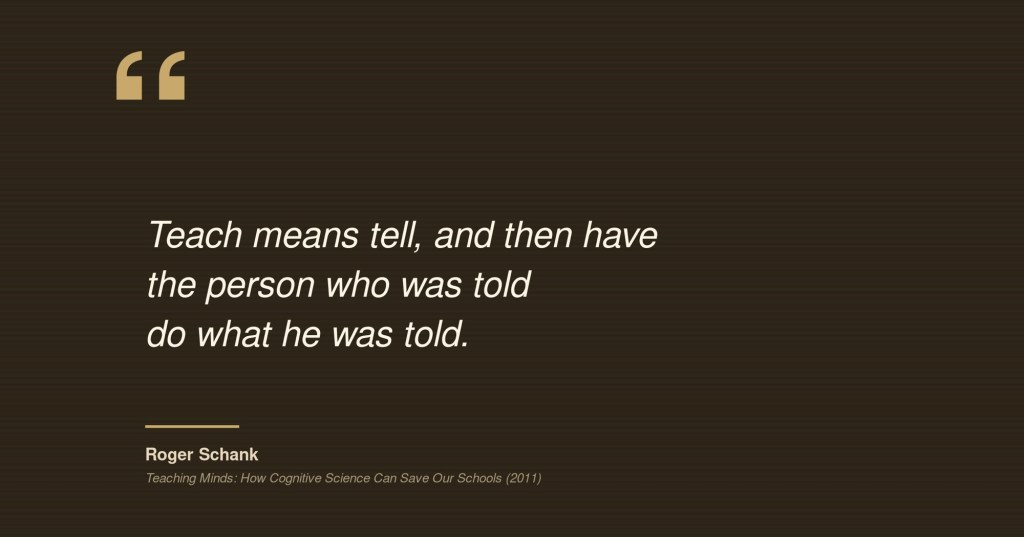
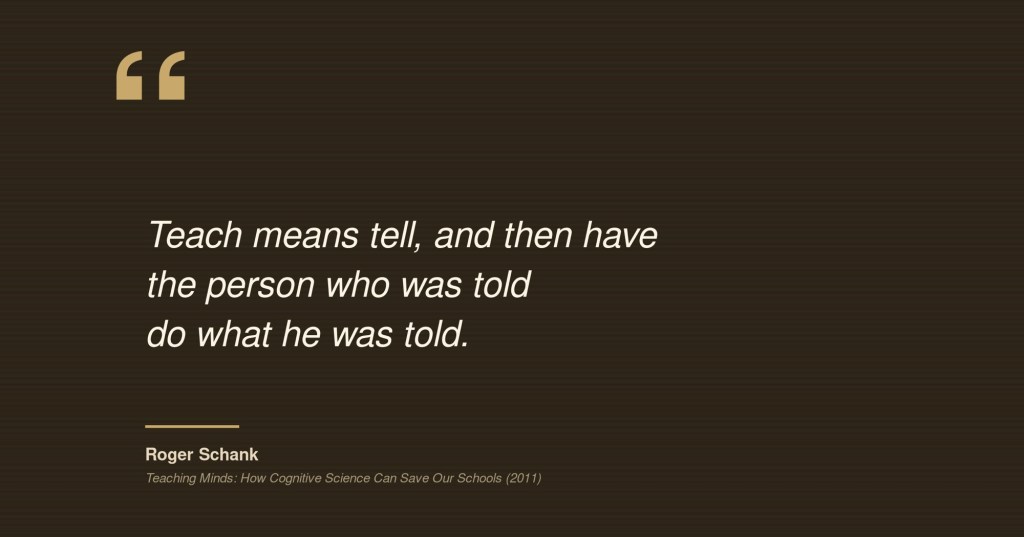
    “Teach” means to tell, and then have the person who was told do what he was told”.

    Reading that, I thought of every lecture hall I had ever sat in. The teacher talked. We listened, or pretended to. Then there were grades. The whole arrangement assumed that listening was learning. It is not.

    James Zull: Learning is biology

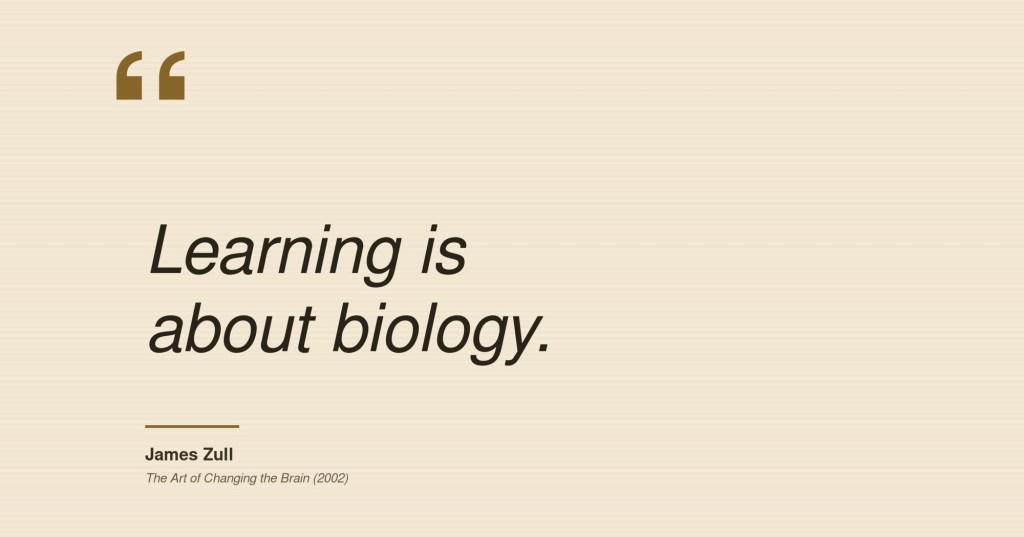
    James Zull, a biologist who ran a university teaching center, comes at the same problem from a completely different angle. His starting line in The Art of Changing the Brain (2002) is disarmingly simple:

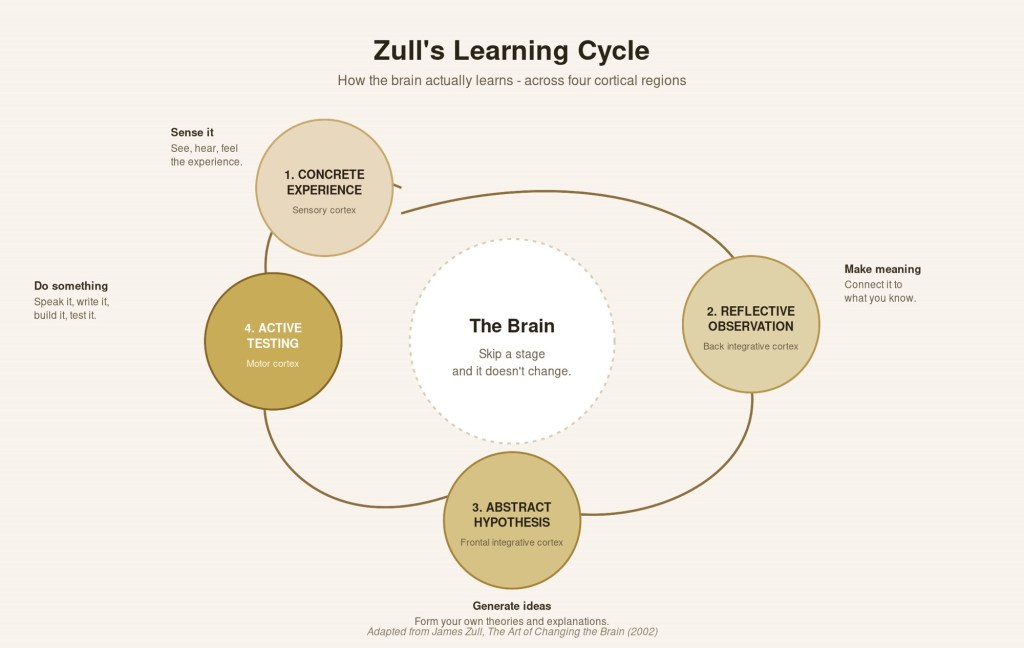
    For Zull, teaching is the art of changing the physical structure of the brain. And that change only happens when the learner moves through all four stages of what he calls the learning cycle:

    1. Concrete experience—taking in something through the senses (sensory cortex).

    2. Reflective observation—making meaning of it (back integrative cortex).

    3. Abstract hypothesis—generating your own ideas about it (frontal integrative cortex).

    4. Active testing — doing something with those ideas (motor cortex).

    Skip any stage and the brain doesn’t fully change. You’ve stored some information. You haven’t learned.

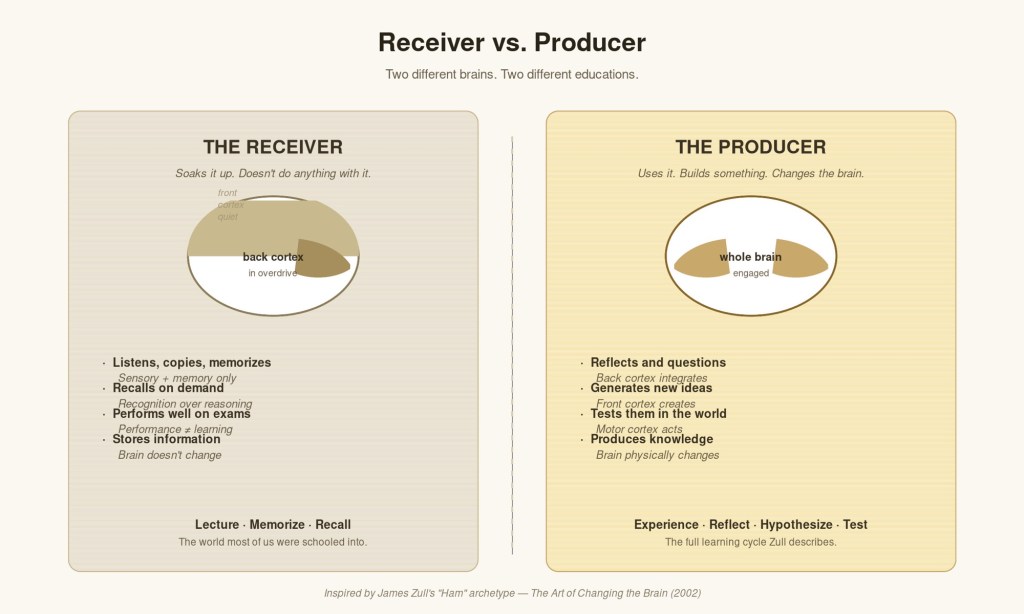
    Zull describes a student archetype he calls “Ham,” someone who soaks up information, remembers a great deal, and never does anything with it. Ham, biologically speaking, is living on one side of his brain. He is a receiver, never a producer, of knowledge.

    I read that passage and recognized myself. I had been Ham. We had been trained to be Ham.

    What both of them are really saying

    Schank and Zull start in completely different places, artificial intelligence and cellular biology, and arrive at the same diagnosis.

    Passive reception is not learning.

    You can sit, listen, copy, and memorize for sixteen years and still graduate without the cognitive equipment that adult life and meaningful work actually require. Not because you’re lazy or unintelligent, but because the system you went through was never designed to develop those capacities in the first place.

    Both also insist that emotion and motivation matter. Schank calls it goal alignment: humans learn what they actually want to learn. Zull points to the emotional centers of the brain that modulate memory and attention. An education that ignores what students care about is working against its own biology.

    What the Kenyan classroom taught me about the science

    Looking back at my schooling through their lens is sobering.

    The 8-4-4 system I went through was, structurally, the kind of education both theorists describe as broken. Curriculum organized around subjects and exam content rather than cognitive growth. Classes are taught by chalk-and-talk to forty or fifty kids at a time. Universities where you literally couldn’t hear the lecturer from the back rows because of lack of PA capabilities. Assessment that rewarded the reproduction of model answers and quietly punished the student who came up with her own.

    We mastered the first half of Zull’s cycle, sensory input and memory, and almost never got to the second half, where actual thinking happens. We checked almost none of Schank’s cognitive process boxes. We learned to perform learning.

    And here’s the part that matters for everyone, not just Kenyans: this isn’t only a Kenyan story. The lecture hall, the closed-book exam, and the curriculum-as-coverage model—these patterns show up in classrooms all over the world. Anywhere education is structured around transmitting content rather than developing minds, the same gap opens up between schooling and learning.

    What I’m taking from this

    I’m not writing this to dismiss my education. It got me into rooms I would not otherwise be in. The teachers I had were doing their best inside a system they did not design.

    But I am writing it because I think most of us, students, professionals, parents, and leaders, carry around a quiet version of the same question I had in that lecture hall. Did I really learn that? Or did I just memorize it well enough to pass?

    A few things I’m trying to do differently now:

    · Treat learning as something I do, not something done to me. If I can’t apply, explain, or argue with an idea, I haven’t learned it.

    · Move through the whole cycle. Read, yes, but also reflect, hypothesize, and test. Write the post. Build the prototype. Have the conversation.

    · Pick goals first, content second. What do I actually want to be able to do? Then I’ll find the books, courses, and people that serve that.

    · Be patient with my own brain. Real learning is a physical change. It is supposed to feel slow.

    The promise of education has always been that it changes you. Schank and Zull, in different vocabularies, are saying the same thing: that promise is real, but it’s only kept when learning becomes active, goal-directed, and complete.

    I wish someone had told me that on the night before the exam.

    Have you ever felt the gap between schooling and learning in your own life? I’d love to hear how you’re closing it.

    Sources: Roger Schank, Teaching Minds: How Cognitive Science Can Save Our Schools (2011); James Zull, The Art of Changing the Brain (2002).

  • The Journey Begins

    Thanks for joining me!

    Good company in a journey makes the way seem shorter. — Izaak Walton

    post